Sheet Cake Arithmetic: How Many Slices a Crowd Really Eats
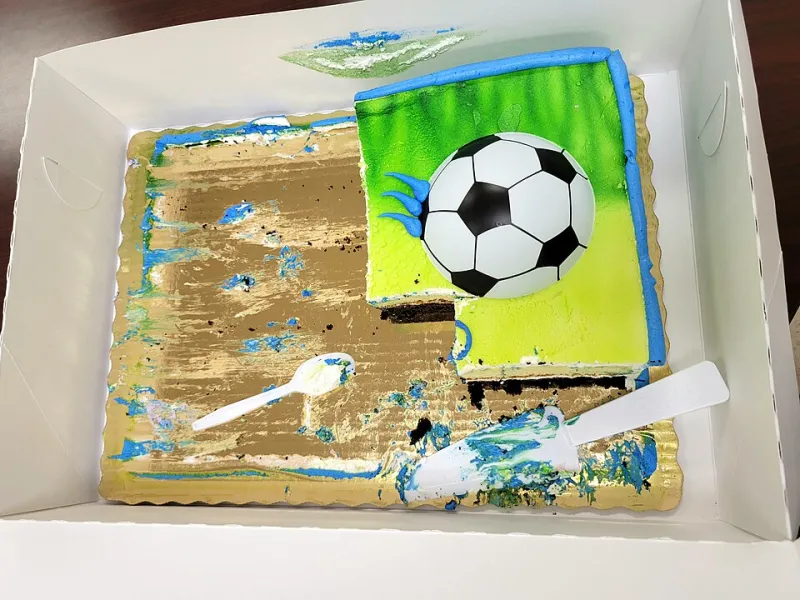
Photo: Kiran891, CC BY-SA 4.0, via Wikimedia Commons
There is a moment at every party when someone stands behind the cake with a knife and does arithmetic in their head. Twelve people are watching. The cake is a half sheet. The knife hovers. Somewhere near the back, a nine-year-old is already asking for the corner piece with the most frosting on it.
That moment is avoidable. All it takes is a little counting before you ever pick up the phone.
The standard chart is not wrong, it is optimistic
Every bakery, including ours, hands out a serving chart. A quarter sheet is listed at roughly 24 servings, a half sheet around 48 to 54, a full sheet over 100. Those numbers come from cutting clean 2-inch squares and assuming every guest takes exactly one.
Real parties do not run that way. The aunt who says she only wants a sliver takes a sliver, then comes back for a second sliver, and by the end of the evening she has eaten a full square and a half. The kids take a square, lick the frosting off, and leave the cake. Somebody's brother-in-law eats three. Your careful 48 slices turn into a cake that is gone by 8:15 with three people still in line.
So the useful question is not how many slices the pan holds. It is how many people, with what appetites, will pass that table.
A size chart that assumes second slices
The middle column is what the pan technically yields. The right column is what we would actually recommend ordering for a mixed crowd with dinner beforehand and dessert grazing afterwards.
| Pan size | Approximate dimensions | Standard servings | Order it for |
|---|---|---|---|
| Quarter sheet | 9 x 13 inches | 24 | 15 to 18 guests |
| Half sheet | 12 x 18 inches | 48 to 54 | 32 to 38 guests |
| Full sheet | 18 x 24 inches | 96 to 108 | 65 to 75 guests |
| 8-inch round, single layer | 8 inches across | 10 to 12 | 8 guests |
| 8-inch round, two layer | 8 inches across, 4 inches tall | 20 to 24 | 15 to 18 guests |
| Two-tier, 8 and 6 inch | stacked | 30 to 36 | 24 to 28 guests |
| Three-tier, 10, 8, and 6 inch | stacked | 60 to 70 | 45 to 55 guests |
Treat the right column as a starting point, not gospel. It already builds in about a 25 percent cushion for second slices and enthusiastic uncles.
The guest mix moves the number more than the headcount
A room of forty adults and a room of forty people where half are under ten need very different cakes.
Kids under eight. They want a piece for the frosting and the sprinkles, and a lot of it ends up on the plate. Count them at about two-thirds of an adult portion, and expect a few untouched squares.
Teenagers. Count them at one and a half. Possibly two. Anyone who has hosted a birthday for a fifteen-year-old knows this in their bones.
Grandparents and older guests. Often a half portion, often shared. Count them at about two-thirds as well, but for a completely different reason.
The 3 p.m. window. An afternoon party where cake is the main event eats heavier than an evening party that follows a full dinner. If you serve cake at a meal, drop the cushion a little. If cake is the entertainment, keep it.
One more variable that surprises people: the number of other desserts. A cake sharing a table with cookies, brownies, and a candy dish will go about 20 percent slower than a cake standing alone. If you are building a full dessert spread, size down one pan and put the difference into the candy bowl.
Round, sheet, or tiered, and what each one is actually for
Sheets are the workhorses. They cut fast, they stack in a car without drama, and they feed a crowd for the least money per serving. If you are hosting a school event, an office lunch, a graduation open house, or anything with a buffet line, a sheet is the honest answer.
Rounds look like a celebration and cut into wedges that feel generous. A two-layer round is the sweet spot for a family birthday up to about twenty people, and leftovers keep beautifully because the cut face is small.
Tiers are for the moment, not the math. Nobody orders a tiered cake because it is efficient. They order it for the entrance, the photographs, and the way the room goes quiet when it comes out. Budget for the drama separately and consider a sheet cake in the back that gets cut and plated so nobody has to disassemble your centerpiece at 9 p.m. Plenty of hosts order both, and it is not excessive. It is just planning.
Five questions worth asking before you order
- How do you define a serving? Get the dimensions. A 1-by-2-by-4 inch wedding slice and a 2-inch party square are nowhere near the same bite.
- How tall is the cake? A two-layer half sheet has roughly double the cake of a single-layer half sheet at the same footprint. This matters enormously and the pan size does not tell you.
- How should I store it before the party? Buttercream and whipped frostings have different tolerances for a warm car and a warm kitchen.
- Will you cut it, or will I? Some bakeries will pre-score the top so your server knows where to aim. It is a small thing that saves a lot of crooked slices.
- Can half the cake be held back? Many shops will box a portion separately so you can serve what you need and keep the rest pristine.
Plan for leftovers on purpose
Some leftovers are a failure. Some are lunch. The trick is deciding which you want before the party, not after.
If you would like the cake to be finished, order to the right column of the chart above and put the cake out late, after people have eaten. If you would like cake for Monday, order the standard size, cut it deliberately, and bring containers. Worth knowing: a cut cake dries at the exposed edges, so leftovers from a round or a tiered cake stay fresher than leftovers from a wide sheet. Sheet cake is the more efficient buy, but round cake is the better keeper.
And if you end up with more than you can eat, send slices home. Nobody in the history of the world has been unhappy to be handed a piece of cake on the way out the door.
We are always happy to talk numbers before you order. That is not a sales pitch; it is just that sizing is the one part of cake that can be solved with a pencil, and it makes the party better when it is.